
No contexto da exposição SLOW AFTER FORM, atualmente patente na UMA galeria até 12 de junho, conversámos com o artista Dylan Silva (Suíça, 1993), radicado no Porto.
A sua prática multidisciplinar, que atravessa a pintura e a escultura, centra-se na memória pessoal e na figura humana, frequentemente evocada através de formas difusas, fragmentadas. O seu trabalho constrói narrativas silenciosas, situadas entre presença e esquecimento. Formado em Multimédia pela Faculdade de Belas Artes da Universidade do Porto, Dylan Silva tem vindo a desenvolver um percurso que cruza investigação plástica e envolvimento ativo na meio artístico independente, sendo cofundador de iniciativas como a Sábado-Feira e a Senhora Presidenta.
Nesta exposição SLOW AFTER FORM patente na UMA Galeria está subjacente a ideia de transformação. Como se manifesta essa dimensão no teu percurso artístico?
A transformação tem sido uma constante no meu percurso, mesmo quando não tinha plena consciência disso. Agora, quase uma década depois, tenho uma perspetiva diferente. Penso que a forma como crio imagens e objetos foi mudando à medida que eu próprio fui mudando.
Houve momentos em que sentia necessidade de construir imagens mais fechadas, mais controladas, quase estáticas, como uma forma de lidar com alguma insegurança ou instabilidade. Hoje interessa-me mais aquilo que escapa, o que fica em suspensão ou em dúvida, esse processo mais instável e em movimento.
Consigo identificar várias pequenas ruturas ao longo do tempo, mas não vejo essas mudanças como cortes absolutos. São antes acumulações. Há coisas que abandono e outras que permanecem, mesmo que transformadas. Quando olho para trabalhos antigos, não os vejo como erros ou fases ultrapassadas. Vejo-os como vestígios de estados mentais e emocionais diferentes. Alguns ainda hoje fazem sentido para mim, outros já não me representam tanto, mas acabam por fazer parte do processo.
Como encaras a tela em branco?
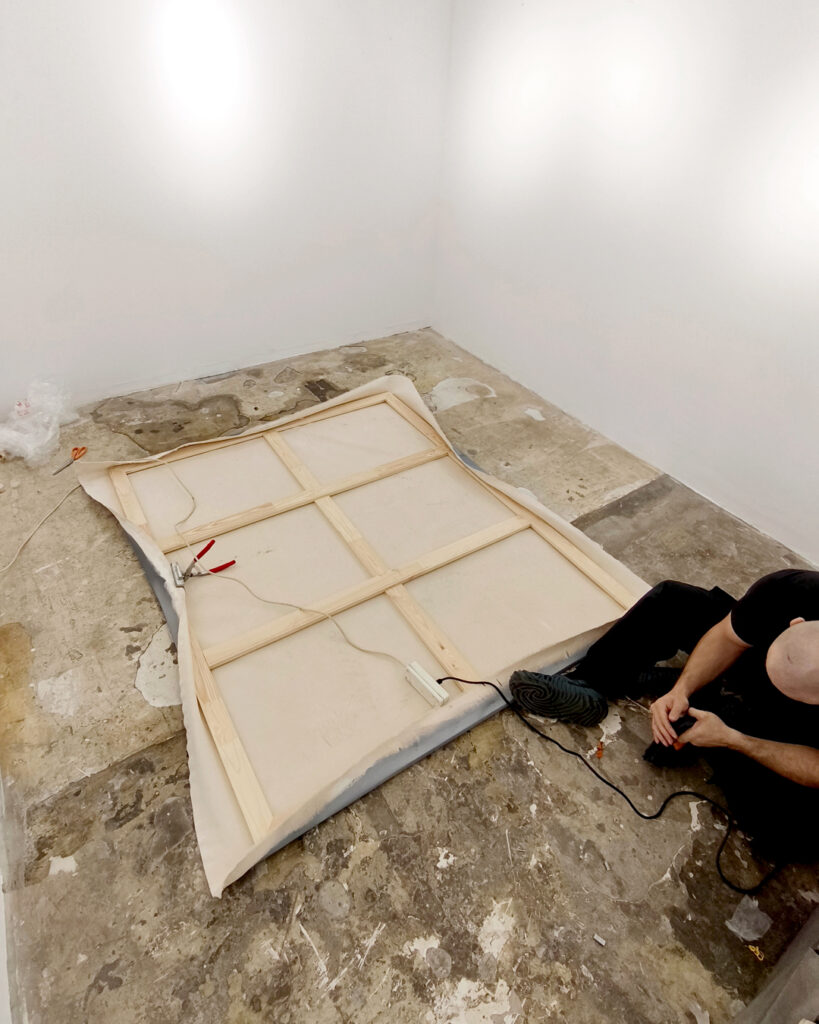
A tela em branco continua a ter alguma tensão para mim. Como muitos descrevem, há por vezes um certo desconforto no momento de começar, porque tudo ainda é possível e indefinido. Existe uma espécie de silêncio inicial que pode ser tanto libertador como, frequentemente, desconfortável.
Normalmente começo com uma ideia mais solta, um rabisco, uma imagem mental ou, por vezes, apenas uma sensação. Apesar de ter alguma noção do resultado que posso querer alcançar, deixo sempre espaço para que a pintura se vá transformando ao longo do processo.
A tela acaba por ser menos um espaço vazio e mais um lugar de negociação entre intenção e descoberta.
E em relação ao fecho de uma obra, reconheces facilmente quando está terminada?
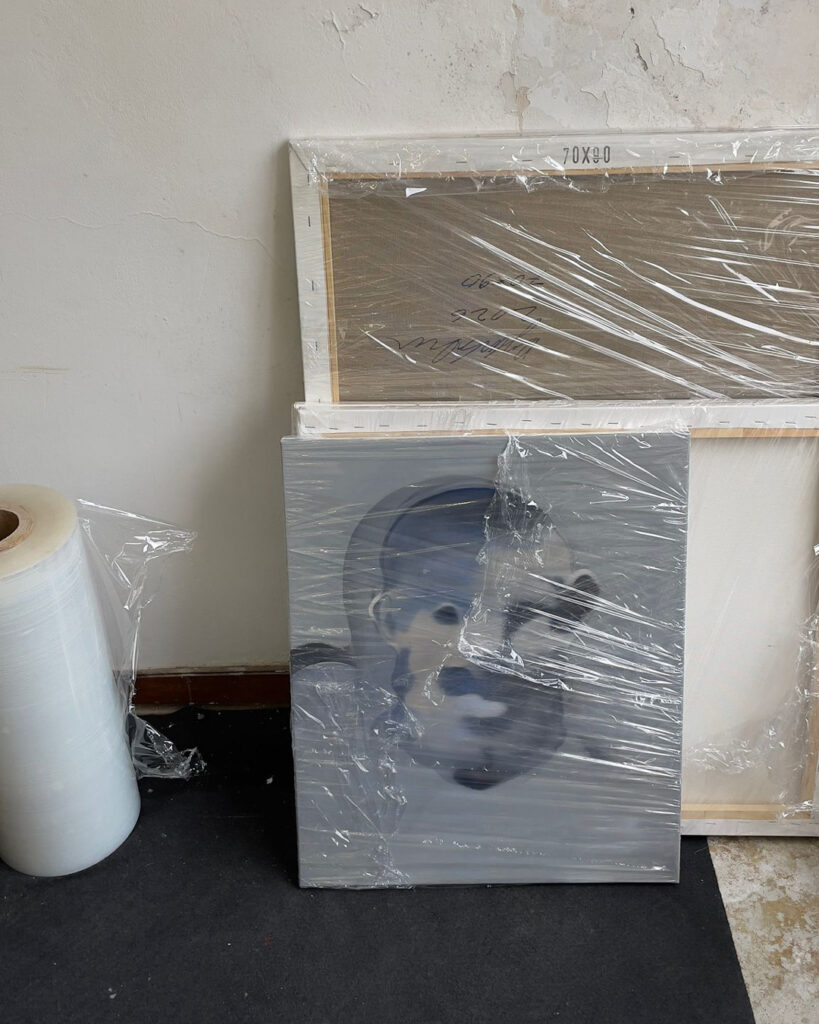
Nem sempre foi assim, mas neste momento sinto que tenho mais facilidade em perceber quando uma pintura está terminada. Às vezes tenho a sensação de que uma obra nunca fica realmente concluída, apenas chega a um ponto em que já não precisa de mais intervenção. Existe uma linha muito ténue entre continuar a aprofundar uma pintura e começar a retirar-lhe aquilo que a mantém honesta.
Muitas vezes preciso de distância para conseguir perceber isso. Há trabalhos que ficam dias ou semanas encostados, até conseguir olhar para eles de outra forma. Por vezes surgem momentos mais claros, quase de certeza, em que percebo que não devo voltar a tocar na pintura.
Que relação estabeleces entre controlo e acaso no teu processo de trabalho?
Existe uma relação bastante instável entre os dois. Como referi anteriormente, muitas vezes começo com uma ideia mais definida, mas dou-me a liberdade para deixar o acaso e algum descontrolo entrarem no processo.
Interessa-me precisamente esse momento em que a pintura deixa de obedecer totalmente àquilo que tinha imaginado. O acaso aparece através dos gestos, dos erros, das sobreposições, do desgaste da imagem e da própria incerteza inerente ao ato de criar. Por vezes, são esses acidentes que tornam o trabalho mais honesto, ou mais próximo de algo humano.
Nunca procuro um resultado totalmente controlado, porque sinto que a contradição, o ruído e a falha fazem parte do processo e o tornam mais verdadeiro.
Não é um processo nem totalmente livre nem caótico. Existe antes uma tentativa constante de equilíbrio entre construir e deixar acontecer. Essas tensões acabam por ser também um exercício mental que me interessa e no qual me reconheço.
Os teus trabalhos parecem sugerir uma certa intemporalidade. Existe alguma influência dos contextos sociais e políticos atuais? De que forma?
Não de uma forma direta ou consciente. O meu trabalho não parte propriamente de temas políticos, mas talvez mais de contextos sociais muito específicos e pessoais.
O que me interessa sobretudo são estados emocionais e psicológicos que atravessam diferentes épocas e contextos. Talvez por isso, talvez, exista essa sensação de intemporalidade. As pinturas não procuram situar-se num momento concreto, mas num espaço mais ambíguo e contínuo. Vejo-as mais ligadas à experiência humana, à transformação e à forma como lidamos com aquilo que carregamos internamente.
Claro que o contexto em que vivemos influencia inevitavelmente a forma como vemos o mundo e a nós próprios, mas isso aparece de maneira indireta, quase absorvida pelo processo, e não como um discurso explícito dentro do trabalho..
Se o público saísse desta exposição com uma ideia ou sensação, qual gostarias que fosse?
Por vezes coloco-me essa questão, mas não tenho uma resposta fechada. Sei que as obras podem gerar diferentes sensações, algumas mais próximas daquilo que quero transmitir e outras completamente diferentes.
Gosto de imaginar que as pessoas possam sair com uma sensação de pausa e reflexão, mesmo que subtil. Não necessariamente com respostas claras, mas com uma maior atenção a esses estados intermédios que, normalmente, tendemos a ultrapassar rapidamente. Vivemos num tempo muito acelerado, onde existe uma pressão constante para resolver, estar presente, comunicar, definir e depois, seguir em frente, quase num ciclo contínuo de repetição.
Com este projeto procuro, de certa forma, o contrário: esse momento em que ainda estamos a processar, quando as coisas ainda não ganharam uma forma totalmente clara.
Se o público conseguir reconhecer alguma parte de si nesses espaços de dúvida, desgaste ou transformação, então sinto que o trabalho já estabeleceu algum tipo de ligação real.
UMA Dialogues with Dylan Silva
As part of the SLOW AFTER FORM exhibition, currently on view at UMA galeria through June 12, we spoke with the artist Dylan Silva (Switzerland, 1993), who is based in Porto.
His multidisciplinary practice, which spans painting and sculpture, focuses on personal memory and the human figure, often evoked through diffuse, fragmented forms. His work constructs silent narratives, situated between presence and oblivion. With a degree in Multimedia from the Faculty of Fine Arts at the University of Porto, Dylan Silva has been developing a career that combines artistic research with active involvement in the independent art scene, having co-founded initiatives such as Sábado-Feira and Senhora Presidenta.
The exhibition SLOW AFTER FORM, currently on view at UMA Galeria, is rooted in the idea of transformation. How does this aspect manifest itself in your artistic journey?
Transformation has been a constant in my journey, even when I wasn’t fully aware of it. Now, almost a decade later, I have a different perspective. I think the way I create images and objects has changed as I myself have changed.
There were times when I felt the need to construct more closed-off, more controlled, almost static images, as a way of dealing with some insecurity or instability. Today, I’m more interested in what escapes, what remains in suspension or in doubt—that more unstable, ever-shifting process.
I can identify several small ruptures over time, but I don’t see these changes as absolute breaks. They are, rather, accumulations. There are things I abandon and others that remain, even if transformed. When I look at old works, I don’t see them as mistakes or outdated phases. I see them as traces of different mental and emotional states. Some still make sense to me today, others no longer represent me as much, but they end up being part of the process.
How do you approach a blank canvas?
A blank canvas still holds a certain tension for me. As many describe, there is sometimes a certain discomfort when starting out, because everything is still possible and undefined. There is a kind of initial silence that can be both liberating and, often, uncomfortable.
I usually start with a looser idea, a doodle, a mental image, or sometimes just a feeling. Although I have some idea of the result I might want to achieve, I always leave room for the painting to evolve throughout the process.
The canvas ends up being less of an empty space and more of a place of negotiation between intention and discovery.
And when it comes to finishing a piece, can you easily tell when it’s done?
It wasn’t always like that, but right now I feel like it’s easier for me to tell when a painting is finished. Sometimes I get the feeling that a piece is never really finished; it just reaches a point where it no longer needs any further work. There’s a very fine line between continuing to develop a painting and starting to strip away what keeps it honest.
I often need some distance to be able to see that. There are works that sit untouched for days or weeks, until I can look at them in a different way. Sometimes there are moments of clarity—almost certainty—when I realize I shouldn’t touch the painting again.
What relationship do you establish between control and chance in your creative process?
There is a rather unstable relationship between the two. As I mentioned earlier, I often start with a more defined idea, but I give myself the freedom to let chance and a certain lack of control enter the process.
I’m interested precisely in that moment when the painting ceases to fully obey what I had imagined. Chance emerges through gestures, mistakes, overlays, the wear and tear of the image, and the very uncertainty inherent in the act of creating. Sometimes, it’s these accidents that make the work more honest, or closer to something human.
I never seek a fully controlled result, because I feel that contradiction, noise, and failure are part of the process and make it more authentic.
It is a process that is neither entirely free nor chaotic. Rather, there is a constant attempt to balance between building and letting things happen. These tensions ultimately become a mental exercise that interests me and in which I recognize myself.
Your work seems to suggest a certain timelessness. Is there any influence from current social and political contexts? In what way?
Not in a direct or conscious way. My work doesn’t really stem from political themes, but perhaps more from very specific and personal social contexts.
What interests me most are emotional and psychological states that transcend different eras and contexts. Perhaps that is why there is this sense of timelessness. The paintings do not seek to situate themselves in a specific moment, but rather in a more ambiguous and continuous space. I see them as more connected to the human experience, to transformation, and to the way we deal with what we carry within us.
Of course, the context in which we live inevitably influences the way we see the world and ourselves, but this appears indirectly, almost absorbed by the process, and not as an explicit discourse within the work.
If the audience were to leave this exhibition with an idea or a feeling, what would you like that to be?
Sometimes I ask myself that question, but I don’t have a definitive answer. I know that the works can evoke different feelings—some closer to what I want to convey, and others completely different.
I like to imagine that people might leave with a sense of pause and reflection, even if subtle. Not necessarily with clear answers, but with greater attention to those intermediate states that we usually tend to rush past. We live in a very fast-paced time, where there is constant pressure to solve, be present, communicate, define, and then move on, almost in a continuous cycle of repetition.
With this project, I am seeking, in a way, the opposite: that moment when we are still processing, when things have not yet taken on a completely clear form.
If the audience can recognize some part of themselves in these spaces of doubt, weariness, or transformation, then I feel that the work has already established some kind of real connection.