
No contexto da exposição STEELBORN – Phase III: Welcome Baby Party, que esteve patente na UMA galeria até 14 de agosto de 2026, conversámos com a dupla de artistas HMX (NL, 1975) e Tiago Hesp (PT, 1981).
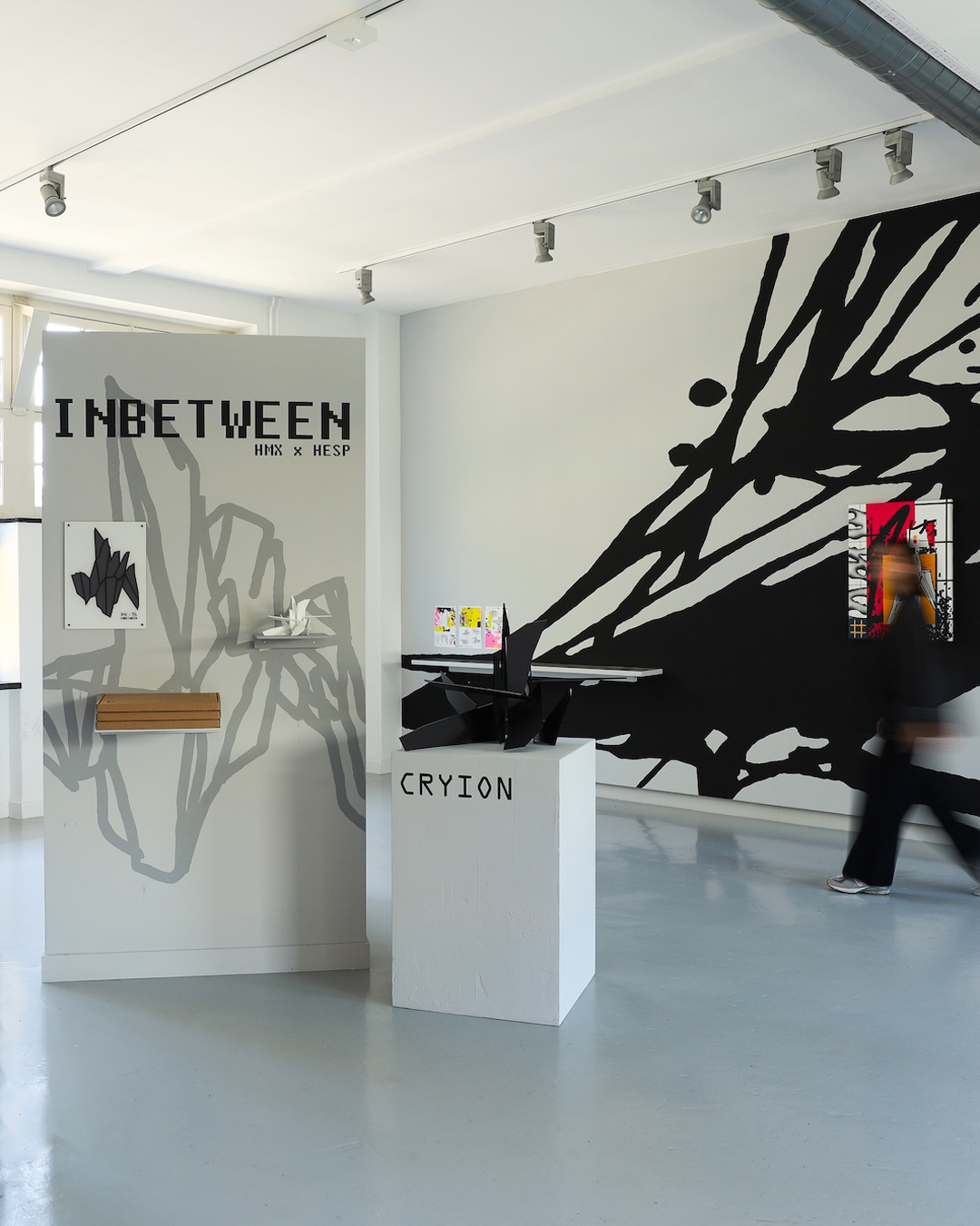
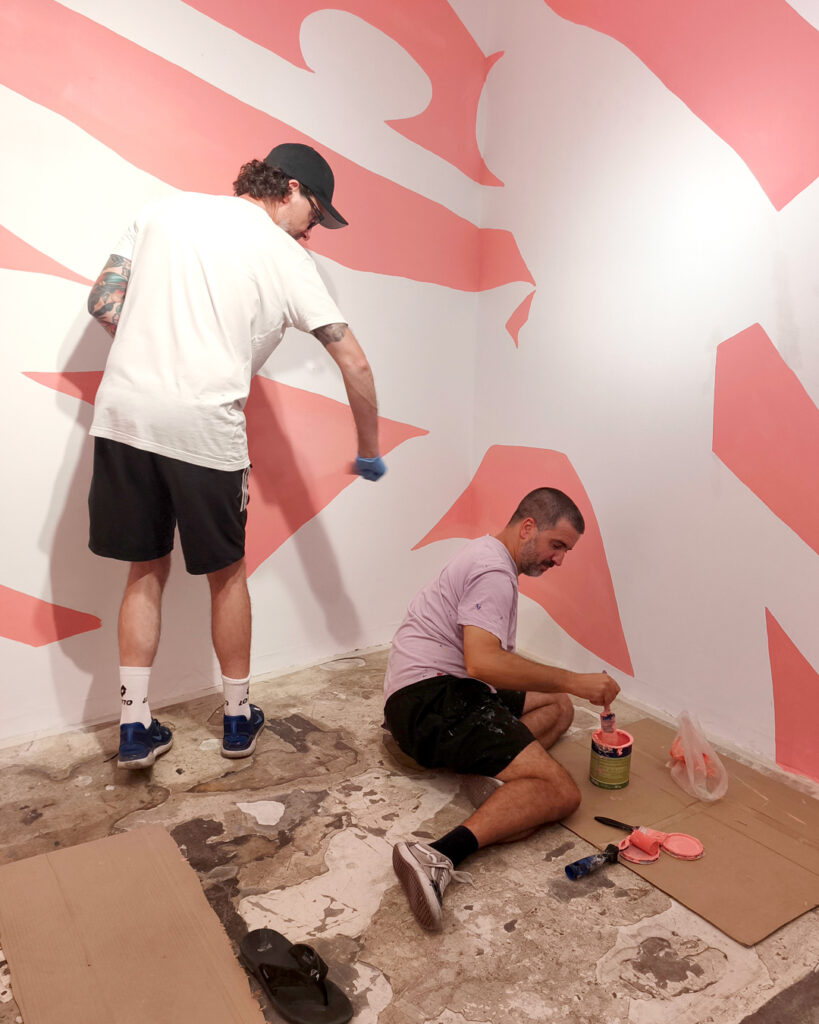
Antes de STEELBORN – Phase III, HMX e Tiago Hesp vinham a desenvolver, ao longo de vários anos, uma colaboração assente na experimentação, no diálogo e na construção de uma linguagem visual partilhada. O encontro entre os dois consolidou-se com “Inbetween”, na galeria Kelderman en van Noort, em Eindhoven, e prolongou-se em novas colaborações, incluindo a realização de murais nos Países Baixos. Deste percurso nasceu aquilo que os artistas definem como uma “terceira mente”, uma forma coletiva de pensar e criar, que ultrapassa as linguagens individuais de cada um.
Como é que se conheceram?
HMX: Contactei o Tiago em 2022 através do Instagram, quando reparei que tínhamos uma linguagem de desenho semelhante. Talvez esse tenha sido já o primeiro passo para a nossa exposição “Inbetween“, em 2024, onde viríamos a descobrir e desenvolver uma linguagem comum.
Na altura, encomendei uma serigrafia do Tiago, mas esta chegou completamente danificada na caixa de correio. O Tiago, claro, enviou-me uma nova. Como forma de agradecer o gesto, enviei-lhe uma obra original e, por sua vez, o Tiago também me enviou uma das suas.
Pode dizer-se que a nossa colaboração começou com um feliz acaso e foi sendo construída através de gestos de amizade, generosidade e compreensão mútua. De certa forma, esse primeiro encontro já continha algo daquilo que viria a definir a nossa parceria artística.
Quais foram os maiores desafios que enfrentaram ao trabalhar em conjunto?
Tiago Hesp: O processo de colaboração teve início em 2024, com a exposição “Inbetween”. Desde o início, não queríamos limitar-nos a apresentar os nossos estilos individuais. A intenção era trabalhar verdadeiramente em conjunto e criar uma linguagem visual comum. Essa procura tornou-se a base do nosso processo artístico.
Trocámos desenhos e ideias online e começámos a reproduzir as linhas e os gestos um do outro no papel. Utilizámos também a técnica de “Inbetweening”, desenhando em direção um ao outro até nos encontrarmos no meio. Mas rapidamente percebemos que o desafio ia muito além de encontrar um estilo de desenho partilhado.
Tratava-se de nos libertarmos de algo que, enquanto artistas, tínhamos construído individualmente e de partilharmos uma forma de desenhar e de pensar. Era necessário pôr o ego de lado e estar verdadeiramente aberto à influência do outro, não apenas enquanto artista, mas também enquanto pessoa.
Sabíamos que esse processo nos iria transformar para além de “Inbetween” e que deixaria marcas nas nossas práticas individuais, algumas visíveis e outras mais profundas, presentes na forma como passámos a olhar para nós próprios enquanto criadores.
Ao mesmo tempo, percebemos rapidamente que o “nós” que estávamos a criar, aquilo que hoje entendemos como uma “terceira mente”, tinha muito para oferecer. Essa descoberta deu-nos a confiança necessária para continuar, mesmo quando o processo nos levou por diferentes camadas de emoções e incerteza.
Abraçamos as lições de vida que emergem dos passos que damos juntos. No nosso primeiro projeto em conjunto, procurámos verdadeiramente encontrar um meio-termo e, dessa ligação, surgiu uma amizade bonita e sincera.
E quais foram as maiores vantagens?
HMX: Ao dedicarmos realmente tempo, logo no início, a conhecermo-nos e a desafiarmo-nos mutuamente, construímos uma base sólida – os chamados pilares nos quais nos podemos apoiar e sobre os quais podemos construir. Também desenvolvemos uma linguagem criativa partilhada, uma filosofia de design e uma técnica de desenho que consistem numa espécie de «terceiro cérebro», ao qual podemos recorrer. Mesmo quando estamos sozinhos no nosso estúdio a tomar decisões artísticas para um projeto conjunto. O que dá jeito quando se vive a milhares de quilómetros de distância e o Wi-Fi não funciona
Ainda assim, ter percursos e perspetivas individuais é precisamente o que torna o trabalho em conjunto tão especial: inspirar-nos e desafiar-nos mutuamente, apresentar ideias que contribuem para o quadro geral, confiar que chegaremos juntos à meta, aconteça o que acontecer pelo caminho.
No projeto Steelborn, percebemos o quanto nos tínhamos tornado positivamente interligados. Isto permitiu-nos trabalhar com grande concentração, fazendo com que o processo de manter a integridade do conceito decorresse de forma bastante harmoniosa.
Por outras palavras, conseguimos aprofundar-nos artisticamente sem nos atrapalharmos uns aos outros nem nos perdermos num labirinto de possibilidades infinitas.
Como surgiu o conceito da exposição na UMA Galeria?
Tiago Hesp: Perguntámo-nos: «O que era o Inbetween?». A primeira palavra que nos veio à cabeça foi «acidente» (de carro). Dois carros, que nos representam metaforicamente enquanto artistas, colidem. Na zona de deformação, surgem padrões inesperados e os elementos entrelaçam-se ao ponto de já não ser possível distinguir o que pertence a quem.
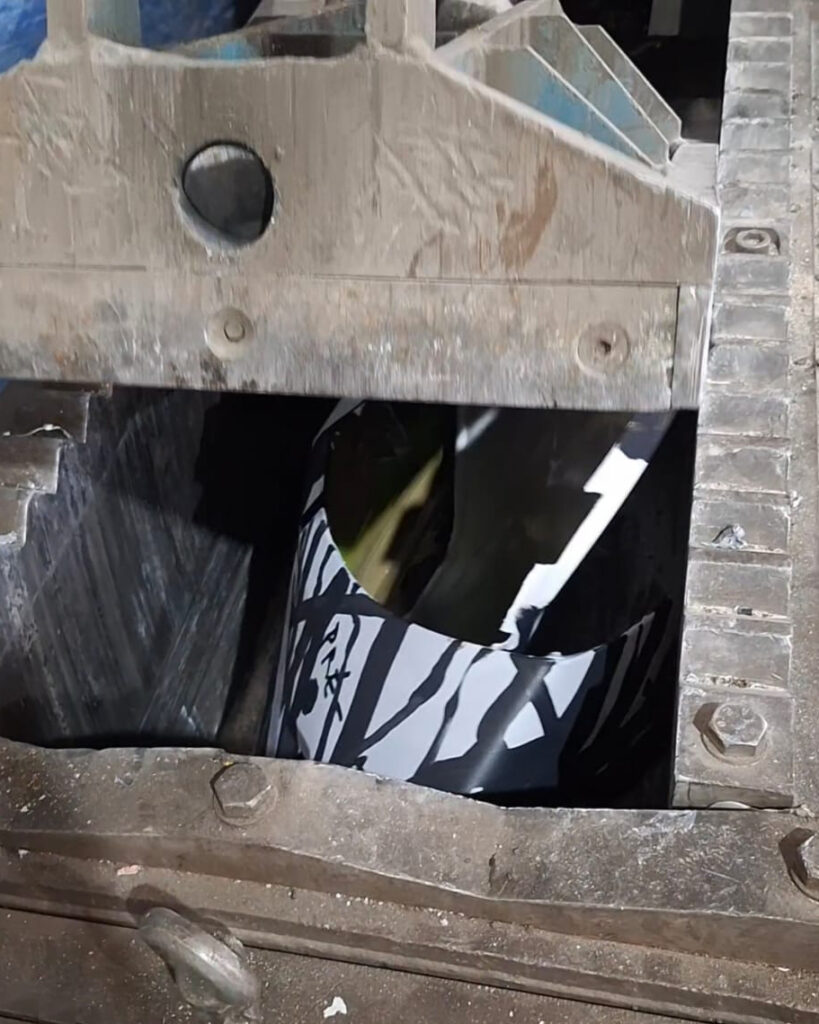
Inicialmente, encarámos «acidente de carro» como uma espécie de título provisório para nos ajudar a debater ideias sobre o que criar para a exposição. Mas a imagem dos dois carros era tão poderosa que decidimos utilizar metal de automóvel. Desde o início, ficou claro que queríamos um momento no processo criativo que estivesse fora do nosso controlo. Idealmente, um momento que definisse o resultado visual. Porquê? Porque, como artistas, queremos aprender a libertar-nos e a aceitar o inesperado. Queremos ver a beleza na imperfeição, olhar para além do próprio acidente.
A máquina que moldou o metal reforçou a ideia de um nascimento. Tal como na criação de uma criança, há duas partes envolvidas cuja influência no resultado é limitada. Mas seja qual for o resultado, vai-o amar incondicionalmente. Foi assim que a ideia de um “bebé Steelborn” ganhou vida. E, claro, quando algo nasce, faz-se uma “Festa de Boas-Vindas ao Bebé”.
Se o público saísse desta exposição com uma ideia ou sensação, qual gostarias que fosse?
HMX: Encontrarmo-nos uns com os outros na “zona de deformação” e encará-la como um espaço criativo para novas possibilidades e oportunidades pode enriquecer-nos, tanto como pessoas como enquanto criadores.
A exposição “Steelborn” fala também sobre colaboração, descoberta e sobre a escolha de encontrar beleza na imperfeição. Vivemos num mundo onde as rugas são apagadas por injeções, onde nem sempre nos ouvimos verdadeiramente uns aos outros e onde tudo parece poder ser suavizado através de camadas digitais e ferramentas de retoque.
É nesse contexto que apresentamos, com orgulho, os nossos belos e enrugados “Steelborn”. Estas esculturas não pretendem ser apenas um deleite para os olhos. Queremos que sejam também um ponto de partida para conversas, em casa ou noutros lugares, e que convidem as pessoas a discutir aquilo que realmente importa.
Aprender a aceitar. Redescobrir a comunicação. Encontrar beleza naquilo que não pode ser corrigido.
UMA Dialogues with HMX and Tiago Hesp
In the context of the exhibition STEELBORN – Phase III: Welcome Baby Party, which was on view at UMA galeria through August 14, we spoke with the artist duo HMX (NL, 1975) and Tiago Hesp (PT, 1981).
Before STEELBORN – Phase III, HMX and Tiago Hesp had been developing, over the course of several years, a collaboration rooted in experimentation, dialogue, and the construction of a shared visual language. Their partnership solidified with “Inbetween” at the Kelderman en van Noort gallery in Eindhoven and continued through new collaborations, including the creation of murals in the Netherlands. From this journey emerged what the artists describe as a “third mind”—a collective way of thinking and creating that transcends each artist’s individual language.
How did you meet?
HMX: I contacted Tiago through Instagram in 2022, when I noticed that we had a similar drawing language. Perhaps that was already the first step towards our “Inbetween” exhibition in 2024, where we would go on to discover and develop a shared visual language.
At the time, I ordered one of Tiago’s screen prints, but it arrived completely damaged in the mailbox. Tiago, of course, sent me a new one. As a way of thanking him for the gesture, I sent him an original artwork and, in return, Tiago also sent me one of his.
You could say that our collaboration began with a happy accident and was gradually built through gestures of friendship, generosity, and mutual understanding. In a way, that first encounter already contained something of what would come to define our artistic partnership.
What were the biggest challenges you faced while working together?
Tiago Hesp: The collaboration process began in 2024, with the exhibition “Inbetween”. From the beginning, we did not want to simply present our individual styles. The intention was to truly work together and create a shared visual language. This pursuit became the foundation of our artistic process.
We exchanged drawings and ideas online and began reproducing each other’s lines and gestures on paper. We also used the “Inbetweening” technique, drawing towards one another until we met in the middle. But we quickly realised that the challenge went far beyond finding a shared drawing style.
It was about letting go of something that, as artists, we had each built individually and sharing a way of drawing and thinking. It required putting the ego aside and being truly open to the influence of the other person, not only as an artist, but also as a human being.
We knew that this process would transform us beyond “Inbetween” and that it would leave traces in our individual practices, some visible and others deeper, present in the way we came to see ourselves as creators.
At the same time, we quickly realised that the “we” we were creating, what we now understand as a “third mind”, had a lot to offer. This discovery gave us the confidence to continue, even when the process took us through different layers of emotions and uncertainty.
We embrace the life lessons that emerge from the steps that we make together. With the firts joint project we truly sought to meet halfway and a beautiful, sincere friendship grew from that connection.
And the biggest advantages?
HMX: By really taking the time at the start to get to know and challenge one another, we built a solid foundation – so called pillars we can lean on and build upon. We also developed a shared creative language, design ethos, and drawing technique that reside in a sort of “third brain,” which we can tap into. Even when we are by ourselves in our studio making artistic choices for a joint project. That comes in handy when you live thousands of kilometres apart and the wifi is dead
Still, having individual paths and views is precisely what makes working together so special: inspiring and challenging one another, coming up with ideas that contribute to the big frame, trusting that you will reach the finish line together, no matter what happens along the way.
In the Steelborn project, we realised just how positively intertwined we had become. This enabled us to work with great focus, making the process of maintaining the concept’s integrity run quite smoothly. In other words, we were able to delve deeper artistically without getting in our own way or getting lost in a maze of endless possibilities.
How did the concept for this exhibition at UMA Galeria come about?
Tiago Hesp: We asked ourselves the question: ‘What was Inbetween?’. The first word that came to mind was (car)crash. Two cars representing us metaphorically as artists collide. Where within the crumple zone, unexpected patterns emerge and elements become intertwined to the point where you can no longer distinguish what belongs to whom.
Initially, we viewed ‘car crash’ as a sort of working title to help us brainstorm what to create for the exhibition. But the image of the two cars was so powerful that we decided to use car metal.From the start, it was clear that we wanted a moment in the creative process that was beyond our control. Ideally, one that would define the visual outcome. Why? Because, as artists, we want to learn to let go and accept the unexpected. We want to see the beauty in imperfection, to look beyond the crash itself.
The machine that shaped the metal reinforced the idea of a birth. Just as with the creation of a child, there are two parties involved whose influence on the outcome is limited. But whatever the outcome, you will love it unconditionally. That’s how the idea of a ‘Steelborn baby’ came to life. And, of course, when something is born you have a ‘Welcome Baby Party’.
If the audience were to leave this exhibition with an idea or a feeling, what would you like that to be?
HMX: Meeting one another in the “crumple zone” and embracing it as a creative space for new possibilities and opportunities can enrich us, both as people and as creators.
The exhibition “Steelborn” is also about collaboration, discovery, and choosing to find beauty in imperfection. We live in a world where wrinkles are erased through injections, where we do not always truly listen to one another, and where everything can be softened through digital layers and retouching tools.
It is within this context that we proudly present our beautiful and wrinkled “Steelborns”. These sculptures are not intended to be merely a visual delight. We want them to become a starting point for conversations, at home or elsewhere, inviting people to discuss what truly matters.
Learning to accept. Rediscovering communication. Finding beauty in what cannot be corrected.